The Far More Questions
Preface & Introduction
By Barry John Johnson
Preface
Years ago, “Miriam” confessed, “I am not as stable a person as people think I am. None of my family or friends know this about me.”
This was a very personal insight to share, which jarred me at the time and haunted me as this book began to take shape.
Miriam was conveying that she put up a front of stability, of “having her act together,” while feeling emotionally unsettled consistently. This facade had become a regular part of her relationships with those she was closest to. I felt simultaneously sad about her situation and honored she chose to confide in me.
She was being authentic with me by revealing her secret inner life while admitting she was not completely authentic with those she most loved.
The idea of a person hiding a part of themselves was not novel to me, but this revelation struck a chord. I saw Miriam’s family as outwardly supportive and loving, even tight-knit. She certainly loved her family. Yet there she was, with a primary concern about being perceived by her family as not having her act together. Furthermore, Miriam, a bright, educated person, wasn’t taking any action to address her stated feelings, like seeking counseling or confiding in any single family member.
Her world was to direct her energies to maintain appearances. This worked for her.
I was a budding, pre-licensed counselor at the time, tending to view life through various lenses of psychology. I would later think: We can be authentic in parts of our lives and not so authentic in other parts. We trade authenticity for belonging. On some level, we consistently fear rejection by those we love. We hold a lot inside, “white-knuckling” our way through life in the context of being within loving relationships of different types. These thoughts made my heart ache!
Years later, I woke up early one morning, inspired to write down these two Far More Questions:
How can I be far more loving today?
How can I be far more authentic today?
Often, I wake up with a “charged” idea that fermented in my deepest sleep, compelled to write it down to give it further consideration later. These two queries were in line with my interests in psychology and the human condition. I was delighted, like I had received a gift, but not quite sure of what to make of it.
There was no immediate thought of a book. I first thought of the two questions as catchy, succinct lifestyle “prompts,” daily reminders to be kind and honest with oneself and others. That’s it; easy-peasy.
The “combo” of love and authenticity intrigued me. They cover a lot of ground. I pondered how these two might be intertwined, or even stand in opposition. What might be loving for oneself may feel unloving for another, as when a person ends a relationship. Others may be very authentic in their grumpiness or intolerance, for example, but those attributes would not be seen as loving. I thought of Miriam, a person who loved her family but could not confide in them.
I wondered if our most authentic selves are naturally more loving and if love serves as a purifying tonic for greater authenticity. It would also seem that not being authentic is a form of denying and not loving oneself.
I recognized that for some, being their most authentic and loving self may subject them to discrimination or other harms that are not loving.
More so, I thought of the Miriam story and part of my own life when I had a distinct personal transformation years before I met her. A deeper dive was likely necessary for these questions.
In my mid-thirties, I experienced a catharsis, releasing a torrent of grief. I was overwhelmed in a manner disproportionate to triggering events. I felt so horrible!
It was a visceral experience as if sadness was a tar exiting through every pore of my body, every exhale, a fog of misery. The grief was condensed, concentrated. I bawled like a baby. There was part of me fighting against what was happening. There was also an intuitive push, telling me to: Purge, Baby, Purge!
Whew! I lost ten pounds in one week. I could not sleep. I ended up in the hands of a capable counselor. In summary, “loss events” served as triggers to release pent-up grief from my father’s death when I was eleven years old! I had told my counselor about having flashback memories of my father’s funeral as I sat in traffic.
It made sense, and I opened up more, releasing grief in a less resistant manner. My counselor helped me with getting into a stance of letting go and allowing the expression of what had been repressed. This would prove to be a valuable skill.
I would come to know I had started a process that was completely changing me as a person. As one example, I had long been a frequent user of marijuana and a binge drinker of alcohol, but within a year of this “purge,” I stopped. I didn’t declare myself sober or abstinent, or put much thought into it. I just had no calling to partake.
I remember one friend saying, “We want the old you back” (to party). That “old me” never came back. I had changed.
I previously presented as extroverted. Outwardly, I had been hard-charging and outgoing. I had rapidly advanced in my career in local government. My social life was active. I burnt the candle at both ends.
I became introverted, introspective, and calm. I took up meditation of my own accord. A fundamental shift had transpired.
Unbeknownst to me, I had been carrying around a truckload of unprocessed grief for twenty-five years before rapidly dispensing that cargo. Miriam was a step ahead of where I had been, as she could vocalize her experience. I had zero idea that I had stuff I’d stashed away.
“Unprocessed emotions always carry a storage fee.”
While I may have been viewed as someone who demonstrated resilience in getting past the death of my father at a young age and succeeding in life, the truth was that I was a champion suppressor, unaware of the impacts of this trauma. In a way, I was stuck, frozen in time, as a sad eleven-year-old boy whose dad had just died, while I was chronologically a thirty-five-year-old man.
In applying the Far More Questions to that transformative experience, I might ask: Was I then more capable of love with so much less stored grief? Was the “new” me more authentic?
With this application, I saw the Far More Questions as more than lifestyle prompts.
Soon thereafter, what seemed an unrelated metaphor came upon me that helped to formulate how to answer the Far More Questions or what stood in the way of being more loving and authentic on a deeper level.
While I was chatting with a friend, “Rose,” she told me she had introduced a clandestine affair into her already hectic life of competing demands between her profession, marriage, spiritual practice, friends, family, volunteer work, personal interests, etc. She tends towards people-pleasing, struggling with saying “no” to further obligations. She was enjoying the affair as a respite, while at the same time, it made her life more complicated. She was stressed, ashamed, and beating herself up about it. She saw herself as an impostor.
While Rose spoke, I was struck by an image of a person swinging a bucket of water around with their arm in a circular manner, so the centrifugal force keeps the contents inside. I told Rose, and the idea brought tears to her eyes as she agreed the image accurately portrayed her life. She was not happy. Her life was, in effect, spinning, and she felt trapped within the hectic nature of the spin, needing to keep it going to hold everything together.
My takeaway was that she added a stressor to her life to keep it all together! It gave her a distorted sense of agency. Her busier, more stressful life distracted her from having to address more profound issues. She acknowledged not feeling authentic. We might infer she was not acting with love, at least to herself, as signaled by her stress, shame, and unhappiness.
A mash-up occurred. I saw this “swinging of the bucket” dynamic as common to many while serving as an obstacle to being more loving and more authentic.
What’s in the bucket? What happens if we stop and empty it out like I had emptied out a bunch of grief?
The bucket contents equate to specific obstacles to answering the Far More Questions. I presumed there was more within my own bucket, and that everybody’s bucket was different.
I came up with twelve common bucket items we may all be trying to contain and balance out in an equilibrium that works for us individually, the “swinging” feeling mimicking the vitality of life.
If we want to answer the Far More Questions, we have to empty these buckets! This book evolved as a framework, or loose model, to explore doing that.
Meanwhile, the two Far More Questions make for excellent daily prompts:
How can I be Far More Loving today?
How can I be Far More Authentic today?
INTRODUCTION
This book is intended to help you explore answers to our two Far More Questions. The short answer proposed here is that removing obstacles is the best path to fulfilling these traits. The focus of the book is on revealing and getting past common obstacles, providing a format for exploration.
Why These Two Questions?
These are the two questions that popped into my brainpan, as they are. I took that with a grain of salt and pressed further. Ultimately, I came to the conclusion to honor the initial idea because these two cover a lot of ground and do so nicely by complementing and playing off each other. Authenticity by itself is value-neutral. It is generally about being of pure form, being true to one’s nature.
Recall the old fable about the scorpion who stung the frog helping him cross the river after promising not to. That was a pure scorpion move! Authentic AF! But alas, it was not a loving move for poor froggy, or the scorpion himself, as, spoiler alert, they both drowned.
If the scorpion had pondered the Far More Questions, perhaps he would have just passed on the froggy ride that day. Authenticity is best tempered with love.
I like the play and tension between the two. Love is authentic in itself, not to be feigned. Authenticity is loving in itself as it honors one’s core being. These two combined, intertwined, promise better outcomes.
When I thought of the biggest regrets of life, they were moments when I could have been either more authentic, more loving, or both. That hit home with me.
I note that the inspiration to explore the two Far More traits came in the form of questions, not edicts. In contrast to a coercive demand to behave accordingly, the inquisitive form drives an approach of curiosity, introspection and an openness to possibilities, which may be more conducive to exploration.
Deconstructive Model
With the recognition that at any one time, we are the sum of our parts, this book proposes a deconstructive model to examine how different parts of the psyche may interact, impacting our behaviors and experiences relative to love and authenticity.
At the core of the model is the idea that there is an authentic loving self — that gorgeous being is swinging a bucket around, with the centrifugal force created, balancing out in an “Equilibrium Persona.” This is the functional version of us, holding everything together, containing twelve key items:
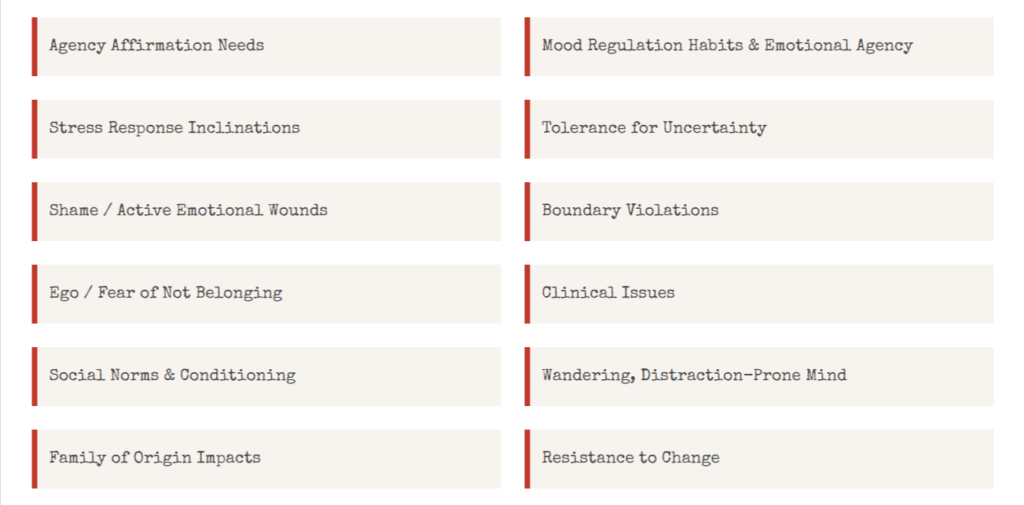
With deconstruction, we set the bucket down and look at each of the items held within and see how they each might be impacting our authentic, loving self. (We might call this our “Shadow Bucket” — a different kind of Bucket List!)
Key Premises & Themes
Unconscious Dynamics: A key premise is that there are unknown dynamics at play in our psyches. Summarizing behavioral psychologist Daniel Kahneman: We are blind to our blindnesses. We don’t know what we don’t know about ourselves.
True Self: There is a true self. It is not stagnant. We evolve, grow, ideally deliberating a stronger sense of self and expressing it. That sense of self may need to be uncovered, revealed, and healed as we take on stifling attributes in the course of living.
“What is the part of who you are that would be the same no matter what culture, family, or body you were born into?”
Shame: Shame is the hobgoblin of human emotions outstaying its useful function, clogging our works, positioning itself as innate. Shame has confirmation bias, seeking out support for its continued presence, discarding conflicting information.
Mystery Over Mastery: Defining love and authenticity is something this book dabbles in, but does not hammer down conclusively. Mystery over mastery assumes there is always something else to learn about ourselves. It leaves room for growth.
— Rainer Maria Rilke
Summed Up: Our struggles might be summarized as follows: We are self-actualizing beings in primitively defended bodies, deathly afraid of being shunned, and not quite sure how to feel about it all. It is in this context that we explore the two Far More Questions.
Working on these two core capacities, or personal healing work in general, takes a certain degree of stick-to-it-ness, AKA perseverance. Many times, I felt overwhelmed. I felt like I hosted a bottomless pit of old, unprocessed pain. As soon as I completed work in one area, another issue made itself known. One step forward, two steps back. I felt forsaken.
But alas, it got better. We can reach a sweet spot, becoming self-healing machines (with professional help). I came to see old, stored pains as nuggets of gold to be mined, making space for something more valuable, a burgeoning equanimity, and a greater sense of authenticity and capacity to love.
Disclaimer-ish; Disclosure-ish
This book is not intended to be academic. I generalize. I simplify. I opine. I take license. I offer up ways to look at things that helped me, which may or may not help you.
This book is not your therapist. I mainly hope to encourage people to be more introspective. You are the captain of your own well-being, but I do wish to normalize going to counseling and getting help as needed, with a caveat that a therapist is not your buddy, but someone who pushes you to areas of discomfort.
I am an imperfect narrator and guide. I am a continuing work-in-progress. I make no claim to being fully actualized in the realms of love and authenticity.
I chose to include a personal backstory in this book. I did this for reference as I discuss various bucket items. It is convenient, and some of my experiences serve to illustrate points brought up.
Part of being authentic involves telling our story, noting that our stories are subject to updates based on new information. Our backstories are not places to live. They are things to unravel and gain understanding from. They should not define us versus inform us as necessary.
I am a believer that we can change the past — not the facts, but in terms of understanding — in terms of how the past, our back stories, impact us in the current moment.
The chapters on authenticity and love are “riffs,” intended to stir thought and introspection of the subjects, or get the juices flowing, before diving into the Bucket Items.
I likely fall into “therapy speak” as I redefine, mash, or simplify terms for this book. For me, the cat is out of the bag on therapy speak. More people have gone to therapy and learned some “speak.” Also, the internet exists, and therapy speak is rampant.
My “therapy speak” warning: We can talk the talk, but we may be intellectualizing or bypassing meaningful progress. Please remember, good therapists go to therapy to work on their own stuff and process material from clients that impacts them. These therapists know the talk but still seek experiential remedies.
Also be wary of therapy speak as a means of excusing behaviors or manipulating others.
Any names I use in this book for various vignettes are fictitious.
My background consists of careers in local government and counseling with commensurate educational credentials and license. I am a cisgender, white, heterosexual male. I am not part of any organized religion. My spirituality focuses on gratitude and empathy. This book is intended to be secular.
Lorem ipsum dolor sit amet, consectetur adipiscing elit. Ut elit tellus, luctus nec ullamcorper mattis, pulvinar dapibus leo.